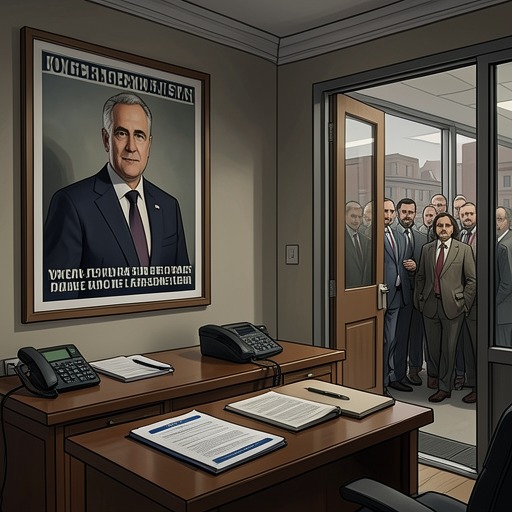
Election Day
Presumed InnocentElection Day marks the end of Raymond Horgan’s campaign to retain the Kindle County prosecutor’s office and the beginning of Nico Delia Guardia’s political ascendancy. The day starts with guarded hopes that the race might still turn, but exit polls bring the defeat into focus: in a county where the party primary is tantamount to election, Horgan’s loss means that the office is passing to his rival.
The contest before Election Day
Eighteen days before the primary, Nico was widely expected to defeat Horgan. Horgan had won over Kindle County’s one and a half million registered voters for more than a decade, but he had not secured the party endorsement. The obstacle was an old factional dispute with the mayor. Horgan’s political allies expected the first public polls to persuade party leaders to pressure the mayor into reversing course, and believed Horgan could then win another four-year term. In this one-party county, the primary was effectively the election.
The campaign’s financial position made that confidence harder to sustain. In earlier, less contested campaigns, Horgan had avoided solicitation for fear that fundraising might compromise his independence. This year those scruples were set aside. Mike Duke oversaw campaign financing, while Horgan addressed groups of well-heeled donors in the polished manner of a candidate presenting himself as the same instrument of justice they had known a decade earlier. Rusty Sabich’s role at one such gathering was to provide Horgan with an excuse to leave so that Duke could press the remaining donors for contributions.
As the campaign weakened, even its inner circle could not dismiss the polling. A national polling outfit produced results worse than Horgan, Duke, and Larren Lyttle had expected. Horgan privately told Rusty that they would lose, describing the defeat as a loss of momentum as well as a setback associated with the Carolyn Polhemus case. His response widened beyond the campaign: after twelve and a half years advocating a revolution in law enforcement, he had reached the limits imposed by too few jails, too few courtrooms, too few lawyers, political favors, and persistent misery and crime. The election therefore tests not only Horgan’s hold on office but also his confidence that a prosecutor’s principles can overcome the county’s institutional constraints.
The vote and the loss
Election Day is bright, and Horgan’s circle finds reasons to hope. The previous evening, Duke had pointed to a poll taken on the day Augustine Bolcarro endorsed Horgan: Horgan was only five points behind. Duke believed the underdog campaign had regained some momentum. The optimism was provisional, but four members of Horgan’s circle sat together as though victory might still be possible.
The prosecutor’s office reflects the complicated relationship between public administration and party politics. During Horgan’s twelve years in office, staff members had been discouraged from working actively on his campaigns, and he had not asked them for campaign donations or even a minute of campaign help. Yet many administrative employees retained political obligations to the party sponsors who had secured their jobs. Under an arrangement Horgan had made with Bolcarro a decade earlier, most staff members were given Election Day off to canvass, distribute leaflets, drive elderly voters, and watch polling places. This year, they performed those duties for Delia Guardia.
Rusty remained at the office, acting as first mate on what he understood to be a sinking ship. About two dozen younger deputies were assigned to a vote-fraud patrol with the U.S. Attorney’s office. Their calls concerned minor or unsupported complaints, such as malfunctioning voting machines, a gun at a polling place, a campaign button worn by an election judge, or excessive advice to elderly voters. Rusty also fielded press calls and reported that there was no sign of interference with the democratic process.
At about 4:30, Dan Lipranzer phoned with the decisive forecast: a contact at Channel 3 had seen exit polls predicting that Nico would win by eight to ten points if the pattern held. Rusty felt the news physically, with his heart dropping and his gut tightening. Looking toward the courthouse columns, the downtown roofs, and the river, he found that a view from an office he had occupied for almost seven years suddenly seemed unfamiliar. His response registered more than a poor forecast; the professional and political world in which he had worked was already becoming strange to him.
Election night and its uncertainty
Later that night, Horgan arrived at the ballroom where his supporters had gathered. Television crews crowded the front, and two of his daughters stood with him on the platform as a band played an Irish jig. Horgan smiled, waved, and thanked the crowd while people stamped, whistled, and began to dance. The public celebration continued even as the result had become grimly clear to those around him.
Lipranzer pushed through the crowd to reach Rusty, then motioned him outside rather than trying to speak over the noise. In an alley beside the hotel, under a streetlamp, Lipranzer appeared deeply troubled and said that something was wrong at the Hall. The account supplies no explanation of what he had discovered. The interruption places an unresolved note beside the election-night spectacle: the crowd’s celebration and Horgan’s performance of composure do not dispel Lipranzer’s alarm.
Consequences and political meaning
Horgan’s defeat ends a tenure that had lasted twelve years and transfers the prosecutor’s office to Delia Guardia. The transition is not simply the replacement of one candidate by another. Horgan’s reflections on the limits of law enforcement suggest that his successor will inherit the same shortages, political pressures, and social problems, regardless of campaign promises. His acceptance that Nico will have his turn carries both exhaustion and recognition that the office cannot escape the conditions surrounding it.
Delia Guardia’s later political fate is separate from this Election Day result. In January, a petition drive led the City Council to authorize a recall election. Nico campaigned to remain in office and nearly survived, but civic leaders including Horgan opposed him, and voters recalled him by about two thousand votes. That later reversal underscores the instability of the political succession set in motion by Horgan’s loss; it does not alter the importance of Election Day as the moment his own administration ended.